Operational awareness and emergency readiness

School operational awareness for movement, accountability, and emergency readiness.

Valkor helps schools understand zone-level movement, pass activity, receiver health, and incident workflows using confidence-aware local signals — not GPS, biometrics, cameras, or home tracking.

No GPSNo CamerasNo BiometricsHuman-controlledLimited Pilots

Operational awareness, zone-level visibility, movement accountability, and school-controlled safety workflows.

Valkor console preview
Valkor command center dashboard showing demo mode, receiver health, system confidence, and incident controls.

Approved Zones

Main hallway, office wing

Overdue movement

2 need review

Receiver health

4 online / 1 stale

Confidence

Likely - 86%

Staff response

Assigned

Readiness

Emergency-ready foundation

Positioning

Supplemental visibility for approved administrators.

Valkor gives schools zone-level operational awareness during school-controlled hours. Humans decide next steps; Valkor supplies context, confidence, and follow-up structure.

Expected movement

Approved hall pass and zone context stays visible to administrators.

Zone confidence

Confirmed, likely, stale, weak, or unknown states are shown clearly.

Staff response workflow

Human teams acknowledge, assign, respond, resolve, and review.

Daily Operations

Daily Operational Visibility

Valkor is designed to help school administrators reduce hallway uncertainty, pass confusion, and incident follow-up gaps.

Hallway accountability

See when students are out on approved movement, when they are overdue, and when movement may need follow-up.

Zone-level awareness

Focus on school-defined areas such as hallways, bathrooms, cafeterias, offices, classroom wings, gyms, exits, and restricted zones - not exact GPS coordinates.

Confidence-based visibility

Show whether a zone estimate is confirmed, likely, weak, uncertain, stale, or unknown instead of pretending imperfect signal data is perfect.

Receiver health monitoring

Give administrators and technical reviewers visibility into receiver status, degraded signals, stale data, and system confidence.

Incident workflow

Support detection, validation, acknowledgement, assignment, response, resolution, and dismissal inside a human-controlled workflow.

Pilot proof reporting

Measure receiver uptime, zone accuracy, false alerts, missed detections, overdue pass detection, response actions, and privacy feedback.

Use cases schools can evaluate

Students out longer than expectedMovement outside approved pass routesHallway or bathroom accountabilityRepeated gathering zonesRestricted-zone visibilityReceiver/device healthStale or missing signal awarenessIncident acknowledgement and resolutionOperational reporting after a pilot or drill

How It Works

Approved signals become operational context.

Approved badges emit local building signals. Fixed receivers detect signals in school-defined zones. Valkor evaluates confidence, freshness, receiver health, and movement context before administrators review operational state.

1

Approved Badge

2

Local Receiver

3

Confidence Engine

4

Admin Dashboard

Valkor tracks zone-level operational state, not exact GPS coordinates.

01

Approved badges emit local building signals

Students or staff in a pilot may carry approved BLE-enabled badges or tags within school-approved areas.

02

Fixed receivers detect school-defined zones

Receivers are placed in selected school-approved areas such as hallways, bathroom entrances, cafeteria entrances, office areas, or restricted zones.

03

Valkor evaluates confidence and context

The system evaluates freshness, receiver health, signal stability, receiver overlap, and movement context before showing operational state.

04

Administrators see state and incidents

The dashboard shows zone-level state, incidents, confidence, stale data, receiver health, and recommended next steps.

Pilot Program

Limited Pilot Structure

Valkor pilots are controlled, measurable, and school-governed. The goal is not full-school deployment on day one; it is to evaluate hallway accountability, pass workflows, receiver reliability, and administrator coordination.

Duration

4-6 weeks

Receivers

3-5

Badges/devices

10-30

Zones

2-4

Use cases

Hall pass movement, overdue trips, route deviation, receiver health, admin follow-up

GPS: NoBiometrics: NoAutonomous discipline: NoEmergency dependency: None

Procurement posture

A pilot should prove daily value without becoming an emergency dependency.

Valkor gives schools supplemental, zone-level operational visibility during school-controlled hours. It helps administrators understand pass movement, overdue students, route deviations, receiver health, and incident follow-up with confidence indicators.

Trust & Privacy

Privacy and Operational Data

Valkor is built around transparent operational intelligence: collect only what is operationally justified, explain it clearly, and place strong controls around it.

Data Valkor may process

Approved badge/device identifiersReceiver identifiersZone identifiersSignal strength readingsTimestampsLast seen statusConfidence statusPass statusMovement eventsIncident eventsReceiver health informationAdmin actionsAudit logsPilot performance metrics

Why this data exists

Zone-level visibility
Hallway accountability
Overdue pass detection
Route deviation detection
Receiver reliability monitoring
False alert reduction
Incident documentation
Pilot evaluation
Historical reporting
Future emergency-routing and congestion intelligence where approved

Trust model

Valkor's trust model is not "collect almost nothing." Valkor's trust model is "collect only what is operationally justified, explain it clearly, and place strong controls around it."

Access control

Approved school personnel onlyAdministrator and assistant principal accessIT/security reviewer access where approvedDesignated responder access by roleSchool-defined deployment boundariesConfigurable retention expectationsAudit logs for accountability

Valkor should not imply that students, parents, or general staff can see live movement data by default.

Confidence-Aware Visibility

Signal data should not pretend to be perfect.

Valkor evaluates signal strength, signal stability, receiver overlap, freshness, receiver health, and movement context before showing operational state.

Confidence states

ConfirmedLikelyWeakUncertainStaleUnknown

When confidence is low, Valkor says it is low. When data is stale, Valkor shows that clearly.

More honest

Confidence-aware state is more trustworthy than pretending data is exact.

More reviewable

Administrators can distinguish movement issues from signal uncertainty.

More operational

The dashboard shows context before action is taken.

System Health

Built to Show System Health

Operational awareness only works if administrators can tell whether the system itself is healthy. Valkor surfaces receiver status, stale data, signal conflicts, missing badge signals, and heartbeat activity.

Health signals

Receiver online/stale/offline statusLast seen timestampsSignal freshnessReceiver conflict indicatorsBadge/device healthUnknown or unapproved device handlingData confidence display

Reliability posture

Valkor is designed to expose uncertainty clearly rather than hide it, helping schools distinguish between a real movement issue and a device or network issue.

Receiver onlineReceiver staleReceiver offlineData freshData staleSignal lostUnknownCandidate zoneConfirmed zoneReceiver conflictLow confidenceNo recent readingDemo modeLive mode

Boundaries

What Valkor Does Not Do

Valkor supports school-controlled operational awareness. It is not designed for unrestricted surveillance.

Valkor does not use

No GPS tracking
No home tracking
No camera surveillance
No microphone monitoring
No biometric identification
No facial recognition
No student-facing app requirement
No public student visibility
No autonomous discipline
No automatic staff dispatch
No consumer-style behavioral profiling
No automatic safety guarantees
No replacement for administrators, teachers, SROs, emergency responders, school policy, or school judgment
No full-school emergency automation in the first pilot

Valkor is designed for

School-hours operational use
School-approved deployment areas
Administrator-controlled access
Zone-level visibility
Confidence-aware alerts
Incident coordination
Operational reporting
Emergency readiness infrastructure
Valkor provides supplemental, school-controlled operational visibility. It does not replace human judgment, school policy, emergency protocols, or administrator discretion.

Incident Workflow

A lifecycle, not just an alert.

Administrators can review, assign, respond, resolve, dismiss, and document operational issues inside a human-controlled workflow.

Detected
Validating
Open
Acknowledged
Assigned
Responding
Resolved / Dismissed

Admin actions

AcknowledgeAssign staffMark respondingResolveDismissAdd resolution reasonView evidence summaryView recommended actionReview incident history

Resolution reasons

Student returnedStaff checkedFalse alertReceiver issuePass correctedManual overrideReal issue resolved

Technical Overview

Technical enough for review. Public enough for restraint.

A public-light view of approved badges, fixed receivers, validation, confidence scoring, receiver health, incident workflow, audit logging, and pilot reporting.

BLE badge or tag

Approved pilot devices emit local signals.

Fixed receiver/gateway

Receivers listen in selected school-approved zones.

Approved device registry

Known devices and receivers are validated before use.

Receiver heartbeat

Health and freshness indicators help reveal stale coverage.

Backend validation

Unknown devices should not become student records.

Raw telemetry separation

Operational displays stay focused on reviewed state.

Zone inference engine

Signals are interpreted as zone-level estimates.

Confidence scoring

The dashboard exposes confidence and uncertainty.

Stale/unknown handling

Loss of signal lowers confidence rather than hiding uncertainty.

Incident engine

Operational issues can move through a review workflow.

Admin dashboard

Approved users see operational state and response actions.

Audit logging

Admin actions can be reviewed during pilot evaluation.

Pilot reporting

Schools receive measurable results and recommendations.

Not published on the public siteReview list
Full API endpoint list
Full database schema
Internal code architecture
Security implementation details
Receiver network details
Exact deployment maps
School floor plans
Raw telemetry examples tied to real people
Detailed vulnerability information

Pilot Success Metrics

Proof points for school and district review.

Metrics that help principals, IT reviewers, safety teams, and advisors evaluate pilot value without expanding scope.

Receiver uptime
Packet reliability
Zone confirmation accuracy
Average confidence score
False alert count
Missed detection count
Stale/unknown signal time
Overdue pass detections
Route deviation detections
Admin response actions
Average response time
Admin usefulness feedback
Privacy/trust feedback
End-of-pilot recommendations

Product Views

Live software proof, presented calmly.

Screenshots from the Valkor dashboard show how command overview, incidents, zones, people, receiver health, and reporting fit together.

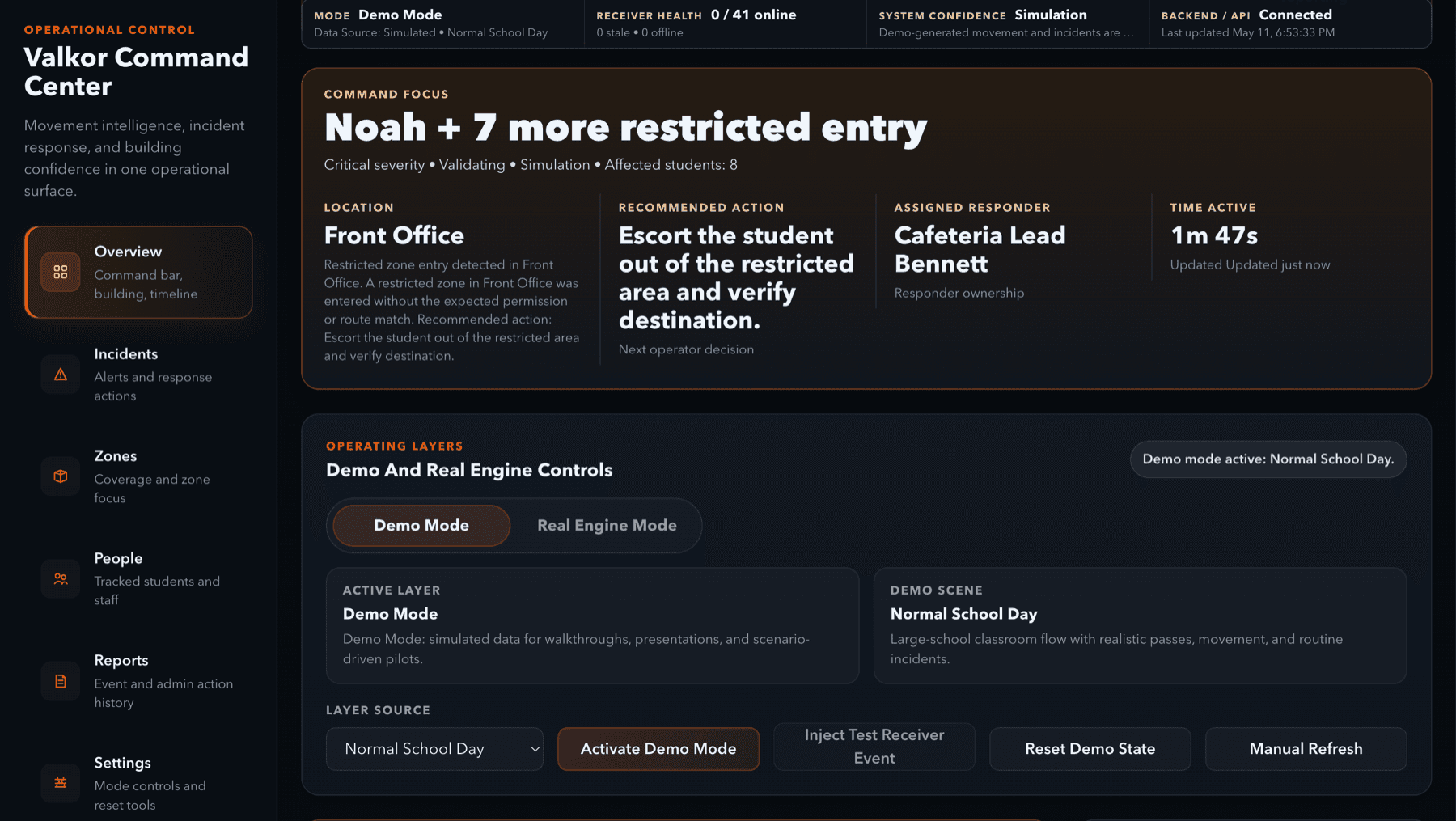
Command center overview screenshot

Command center overview

Demo/live mode, receiver health, backend status, and command focus.

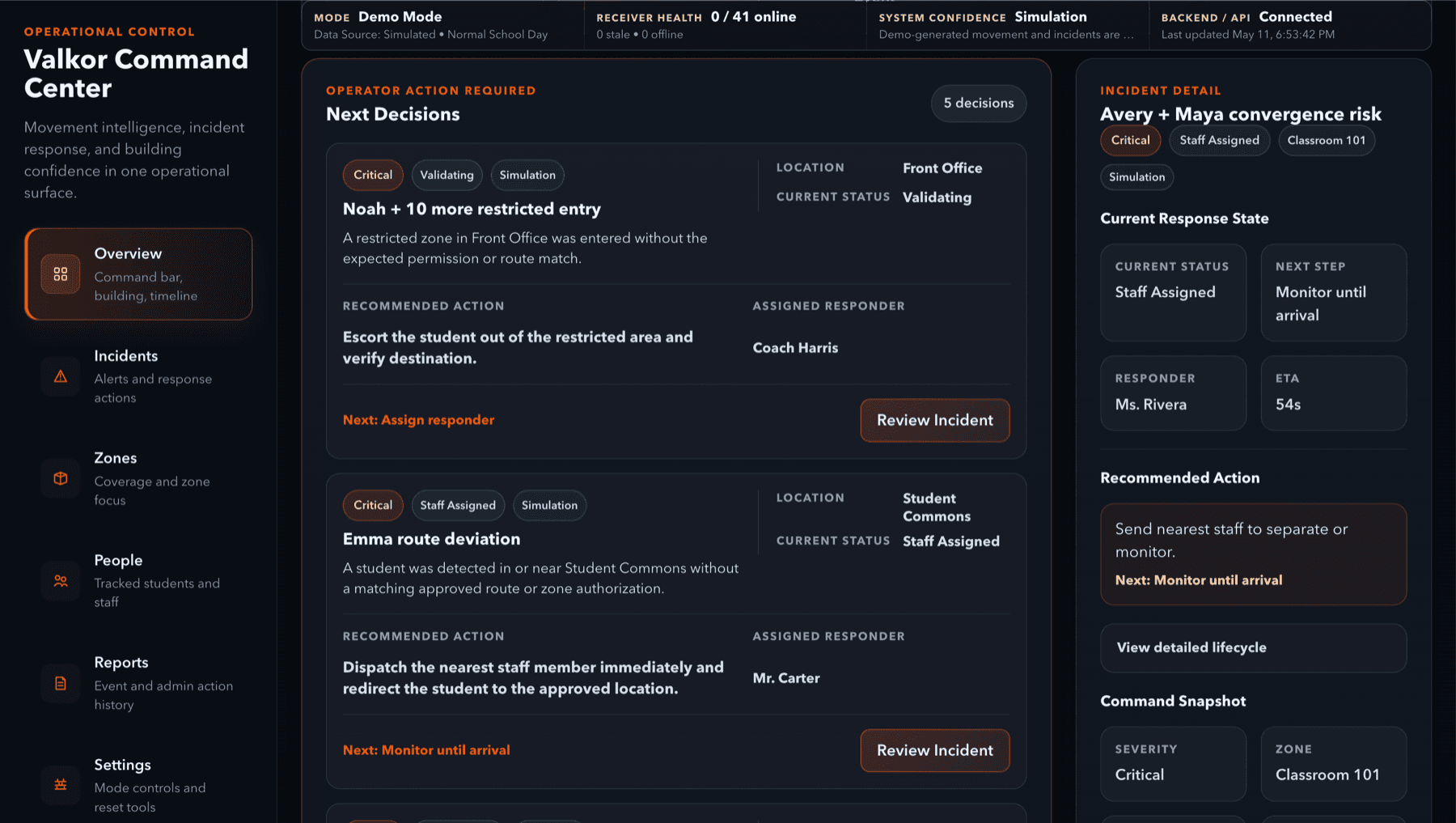
Incident decision workflow screenshot

Incident decision workflow

Recommended actions, responder assignment, next steps, and review controls.

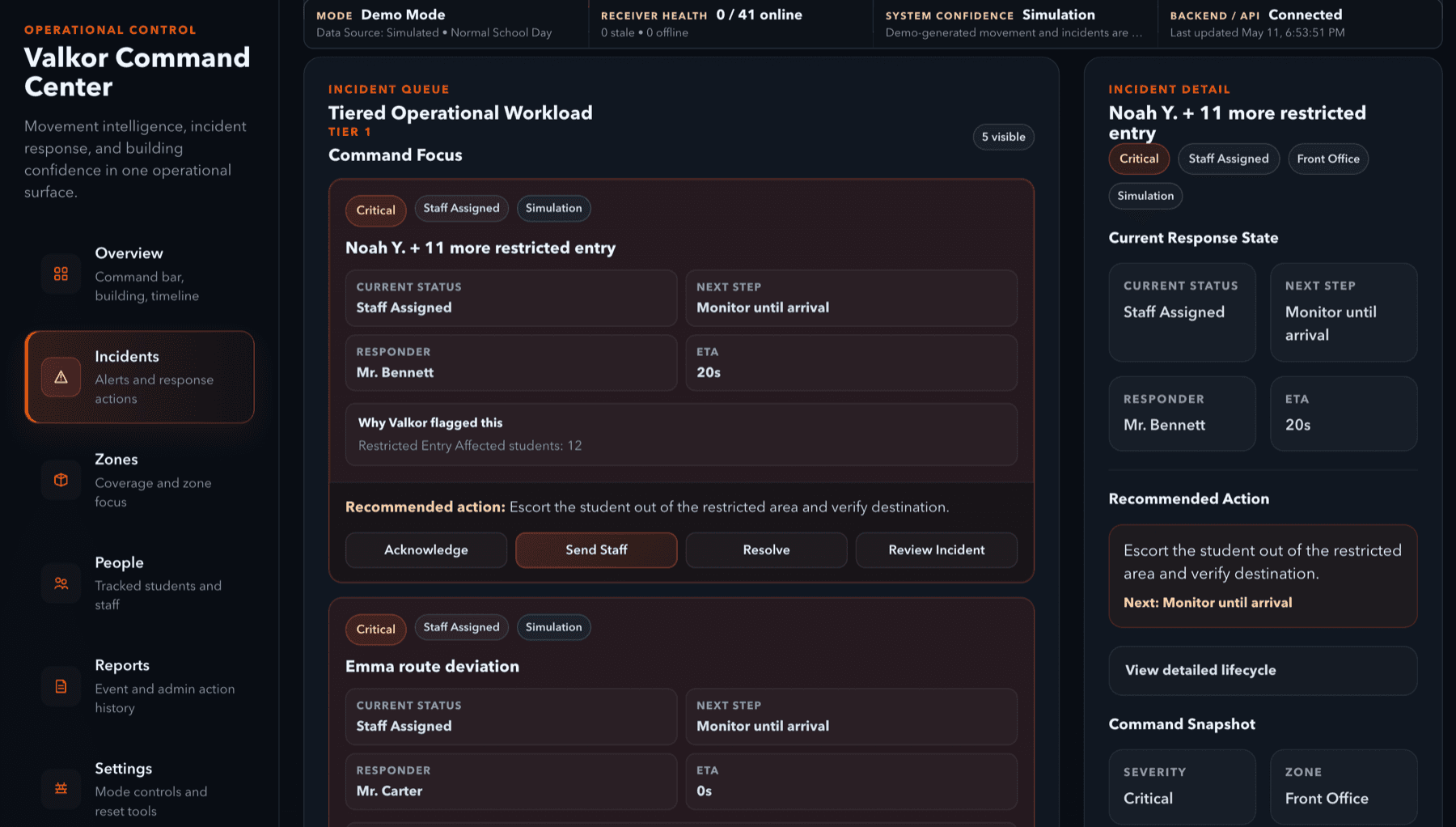
Tiered incident queue screenshot

Tiered incident queue

Critical items grouped with response state, ETA, and recommended action context.

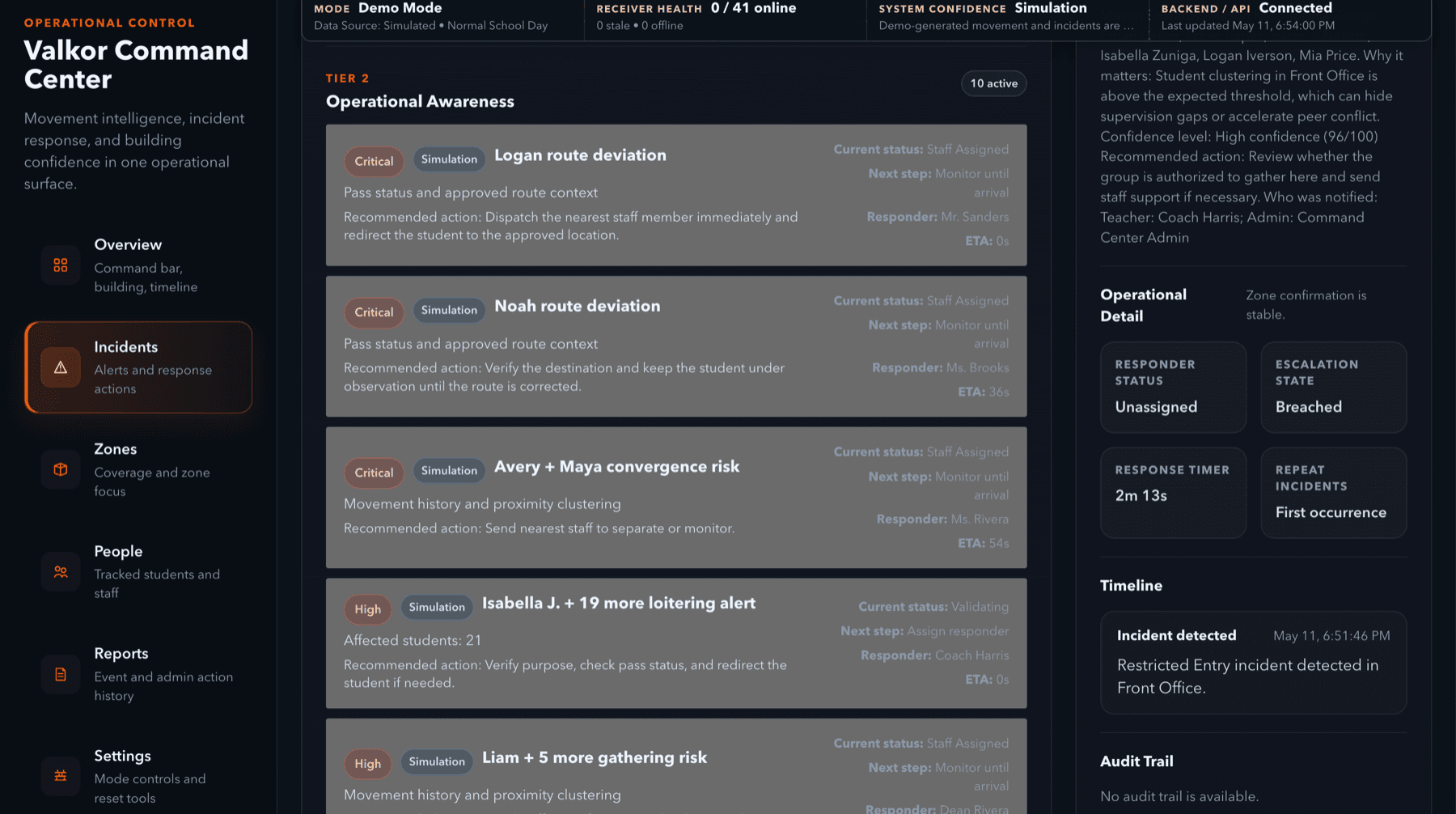
Operational awareness feed screenshot

Operational awareness feed

A lower-density incident view for route deviations, gathering risk, and response timers.

Engine incident signals screenshot

Engine incident signals

Current engine-generated incidents with zone, person, severity, and recommended action.

Zone coverage screenshot

Zone coverage

Occupancy, receiver health, issue state, and coverage confidence by zone.

People and personnel view screenshot

People and personnel view

Current zone, pass status, movement state, and confidence for approved review.

Reports and history screenshot

Reports and history

Administrative action history and incident detail stay connected for review.

Product proof includes

Dashboard overviewPeople/zone stateConfidence indicatorReceiver healthStale data warningIncident workflowPilot report metrics

These visuals intentionally show confidence, freshness, incidents, receiver health, and uncertainty rather than fake perfect certainty.

Mission

Built for operational confusion schools already face.

Valkor was built around a simple operational problem: during normal school days and critical incidents, administrators often lack clear, real-time visibility into movement, accountability, and follow-up.

Movement accountability

Reduce confusion around pass activity, overdue movement, and route deviation visibility.

Emergency readiness

Build trusted operational visibility before higher-stakes emergency coordination layers.

Operational intelligence

Help schools understand receiver health, confidence levels, incident follow-up, and pilot results.

Valkor is designed to give schools a calmer, more structured way to understand what is happening, where uncertainty exists, and what actions need attention.

FAQ

Questions school leaders ask first.

Expandable answers keep the homepage clean while preserving the trust details reviewers need.

Is Valkor student tracking?Open

Valkor is best described as school operational awareness, not consumer-style tracking. It provides zone-level visibility during school-controlled use so administrators can understand movement, pass status, stale data, and incidents.

Does Valkor use GPS?Open

No. Valkor's pilot positioning is zone-level and school-controlled, not GPS-based.

Does Valkor follow students home?Open

No. Valkor is designed for school-controlled operational use, not home tracking.

Does Valkor use cameras, microphones, or biometrics?Open

No. Valkor does not use cameras, microphones, facial recognition, or biometric identification.

Does Valkor automatically discipline students?Open

No. Valkor can surface operational information and recommended actions, but humans remain in control.

What does zone-level mean?Open

Zone-level means Valkor estimates areas such as hallway, bathroom entrance, cafeteria, office, classroom wing, gym, exit area, or restricted zone. It is not trying to show exact foot-by-foot location.

What happens if Valkor is uncertain?Open

The dashboard should show confidence and freshness states such as confirmed, likely, weak, uncertain, stale, or unknown.

What happens if a receiver goes offline?Open

The dashboard should show receiver health and avoid pretending the area has reliable live data.

Who can access Valkor?Open

Access should be limited to approved school users based on role and pilot configuration.

What data does Valkor collect?Open

Depending on deployment, Valkor may process approved badge IDs, receiver IDs, zone IDs, timestamps, signal readings, confidence states, pass events, incident events, receiver health, admin actions, and audit logs.

Is emergency routing part of the first pilot?Open

No. Emergency coordination is a long-term product layer. The first pilot should focus on live zone awareness, school operations, reliability, and trust.

Resources

Trust Center resources.

Public materials can be shared as they are approved. Deeper technical and deployment materials are available for school, district, IT, and safety review.

Available on request

Valkor One-Page OverviewAvailable on request
Pilot Program OverviewAvailable on request
Privacy & Operational Data OverviewAvailable on request
What Valkor Does Not DoAvailable on request

Coming soon

Parent-Facing ExplanationComing soon
IT & Security Review BriefComing soon
Pilot Success Metrics TemplateComing soon
Failure & Downtime Handling OverviewComing soon
Alert Escalation LogicComing soon
Demo WalkthroughComing soon

Roadmap

Current Platform Focus

Valkor separates the current pilot-ready platform from the long-term emergency coordination vision.

Current focus

Zone-level school movement awarenessHallway/pass accountabilityOverdue movement visibilityRoute deviation detectionReceiver healthConfidence-aware operational stateIncident coordinationPilot reporting

Future development areas

Emergency command modeLive accountability during drills or emergenciesHazard-aware routingCongestion-aware movement intelligenceEvacuation optimizationStaff coordination workflowsAfter-action reporting

Blocked route awareness

Future routing work could help evaluate corridors or exits that are unavailable.

Crowding and congestion context

Future models could account for crowding, hazards, and changing building conditions.

Decision support only

Future routing intelligence would assist trained leaders, not replace emergency procedures.

School approval required

Any future emergency layer should be deployed only within approved school policy.

Valkor's first objective is to prove reliable, controlled operational visibility. Emergency coordination becomes stronger after the foundation is trusted.

Emergency routing is a future infrastructure layer, not the first pilot dependency. Any future routing intelligence would be decision support for trained school leaders and would not replace school emergency procedures or guarantee outcomes.

Operational Trust Stack

No GPSNo biometricsNo camerasNo microphonesNo home trackingZone-level visibilitySchool-controlled accessConfidence-aware alertsReceiver health monitoringPilot-ready deploymentHuman-controlled workflows

Pilot Review

Start with a controlled operational awareness pilot.

Limited scope. School-approved access. Human-controlled workflow. No GPS, cameras, biometrics, autonomous discipline, or emergency dependency in the first pilot.

Prefer email? Contact jackson@valkorsystems.com. Valkor pilots are limited, school-controlled, and designed around clear privacy, reliability, and success metrics.